Is kitesurfing dangerous?
Yes, it can go badly wrong. And it almost always goes wrong for the same three reasons: the wind was in the wrong direction, there was too much of it, or there was something hard where the wind blew you. You can see all three in advance.
GuideWith figures from Dutch research and advice from the KNRM, the Dutch lifeboat service8 minute read
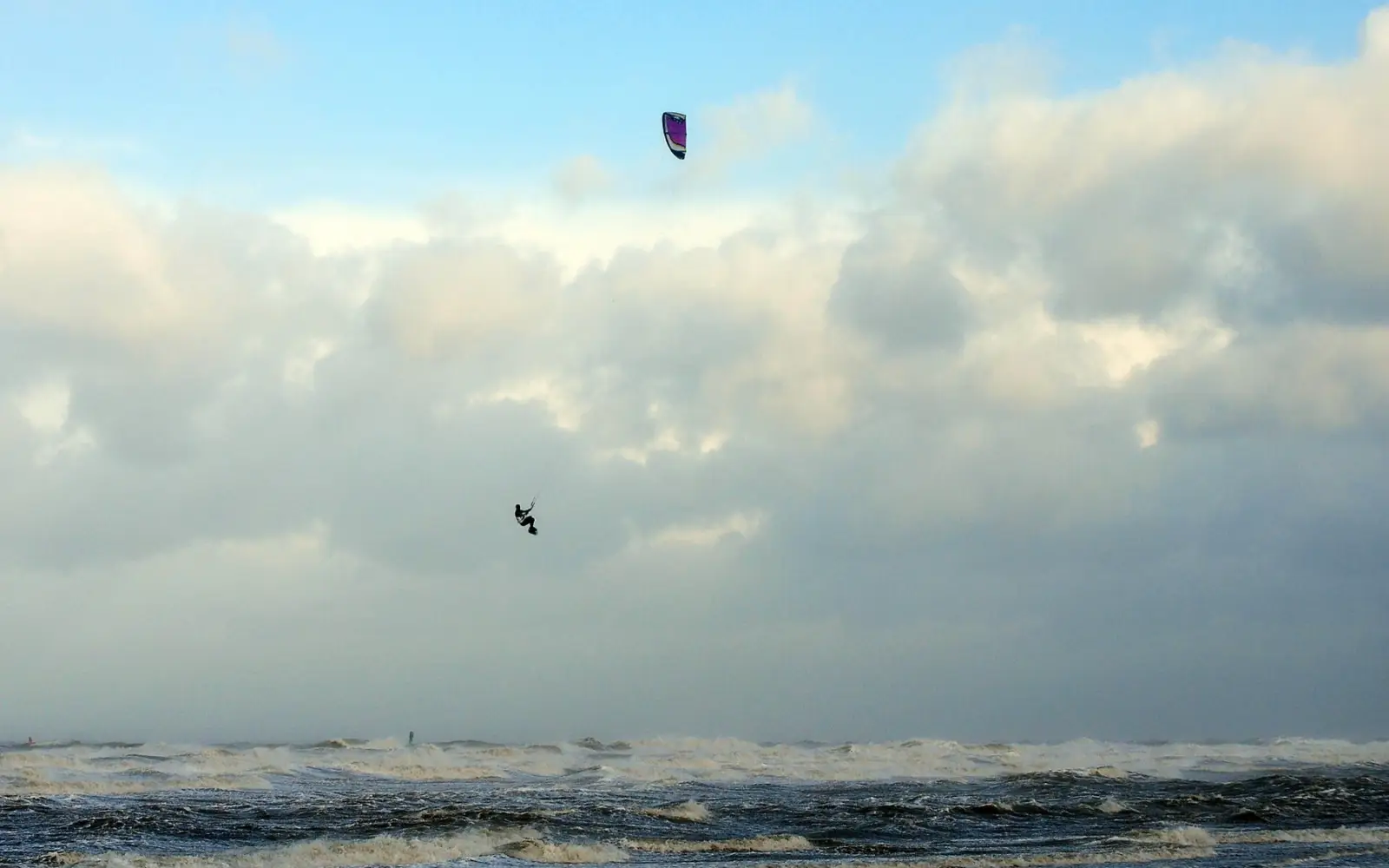
What happens to you depends more on the place and the day than on how good you are. A good kiter on an offshore day runs more risk than a beginner in 18 knots side-onshore. That is why experienced kiters pick the day first, and only then the trick.
First the numbers, because they exist. Doctors at a hospital on the North Sea coast kept track for two years of everyone who came in with a surfing injury. They counted 7 injuries per thousand hours of kitesurfing, against 5.2 for windsurfing.1 A later survey of 194 Dutch kiters came out higher.
10.5injuries per 1000 hours on the water
177 injuries in 16,816 hours on the water. The researchers add: "Most injuries are relatively mild, although kitesurfing has the potential to cause serious injuries."
Van Bergen and colleagues, World Journal of Orthopedics, 2020.2
What does a number like that mean? If you ride fifty hours a year, on average you pick up something every other year, and usually it is a cut or a bruise. Nobody loses sleep over that. It is about the rare times it really goes wrong, because then it goes badly wrong. That is what the rest of this article is about.
01Offshore wind
This is the word people look up most, usually after someone mentioned it on the beach. The difference is simple. Onshore wind blows from the sea to the land and pushes you towards the beach. If something breaks, you wash ashore. Offshore wind blows from the land out to sea. If your kite drops, you drift away from the shore, and swimming back means swimming against the wind with a kite dragging behind you.
Turn the wind over the beach
45 degrees
The treacherous part is that offshore wind feels pleasant at the water's edge. The water is flat, there are no waves to knock you over and no surf to get through. You only notice what is going on when you are a hundred metres out.
Offshore wind is a real NO-GO in 99% of cases! (translated)
Offshore wind is also nearly always gusty, because it comes over houses, dunes and trees. Behind every obstacle there is a hole. Just off the beach the wind then drops away every half minute and picks up again, exactly where you don't want to lose it.
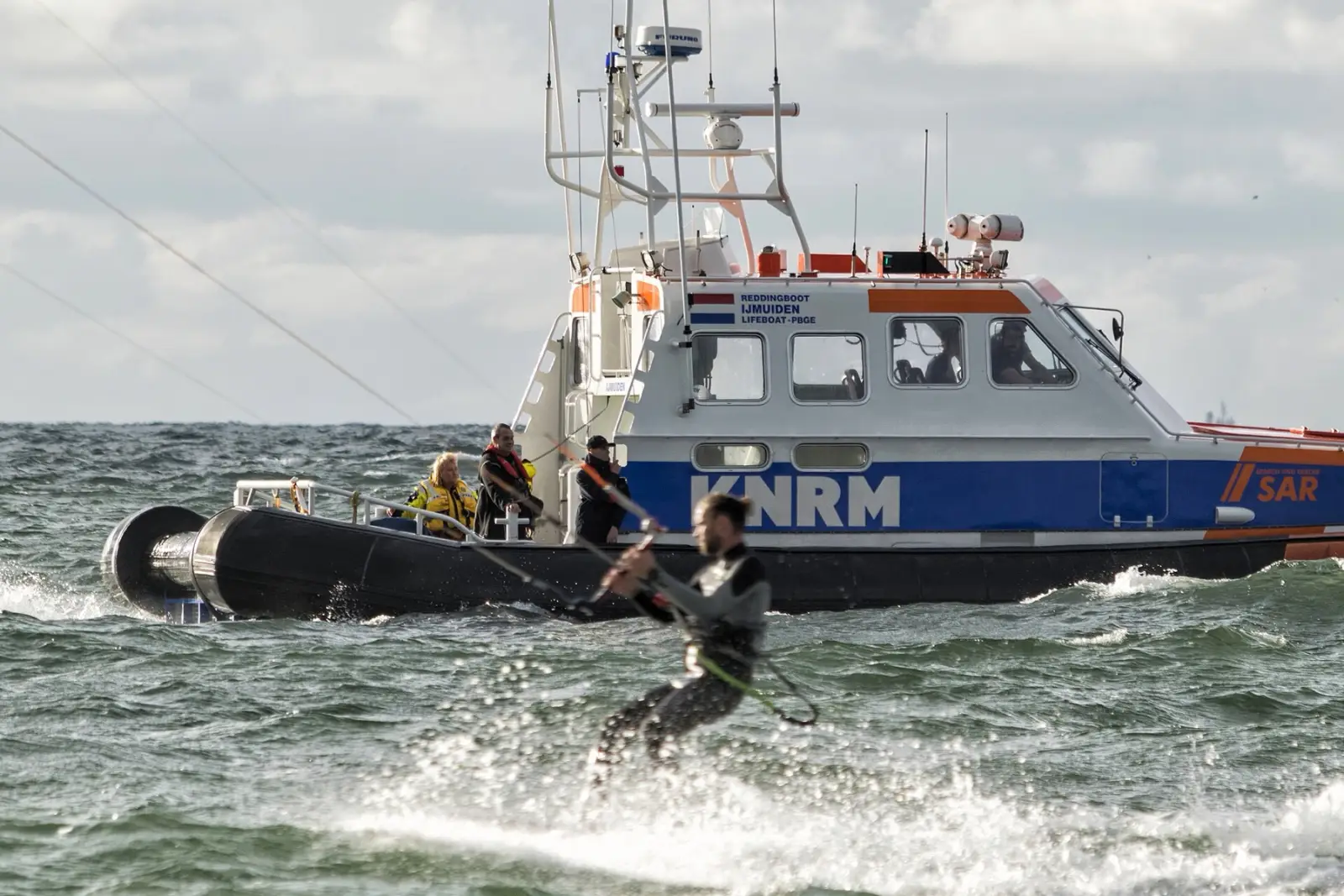
The KNRM, who in the end pull the kiters out of the sea, put it like this: surfing is "usually only possible and fun with onshore or side-onshore wind. That way you can always get back to the place where you went into the water." (translated)4
02How this site judges the wind angle
For each of the 63 spots on Kitewind, it is fixed which wind directions are safe. The forecast works out for every hour how the wind meets the beach, and gives it a name:
| Angle | Name | How it rides |
|---|---|---|
| 0 to 20° | Straight onto the beach | Safe, but launching and landing are hard work. |
| 20 to 70° | At an angle onto the beach | The best angle. You ride back and forth easily and get pushed towards the shore. |
| 70 to 90° | Along the beach | Good for riding, but stay close to the shore. |
| above 90° | Offshore | The wind blows from the beach out to sea. |
If the wind is offshore, the hour turns orange and does not count as a session, however good the wind is. A few spots have a second safe side because of their shape, such as a peninsula with a lagoon behind it. There the site tells you which side you can use.
03Too much wind
The second reason. The limit on this site is hard: above 40 knots an hour no longer counts, whatever else is right. Between 30 and 40 knots it can go fine, with a small kite and an eye on the gusts.
That 40 is not a law. It is the point where even experienced kiters on their smallest kite have no margin left. A kite school puts it the same way in its handbook: "We don't recommend going out in wind greater than 40 knots. There is little margin for error in high winds".11 A Dutch school sets 28 knots as the upper limit for beginners, and writes that above that only very advanced kiters still go out on the water.12 So for most people, 30 is already the ceiling.
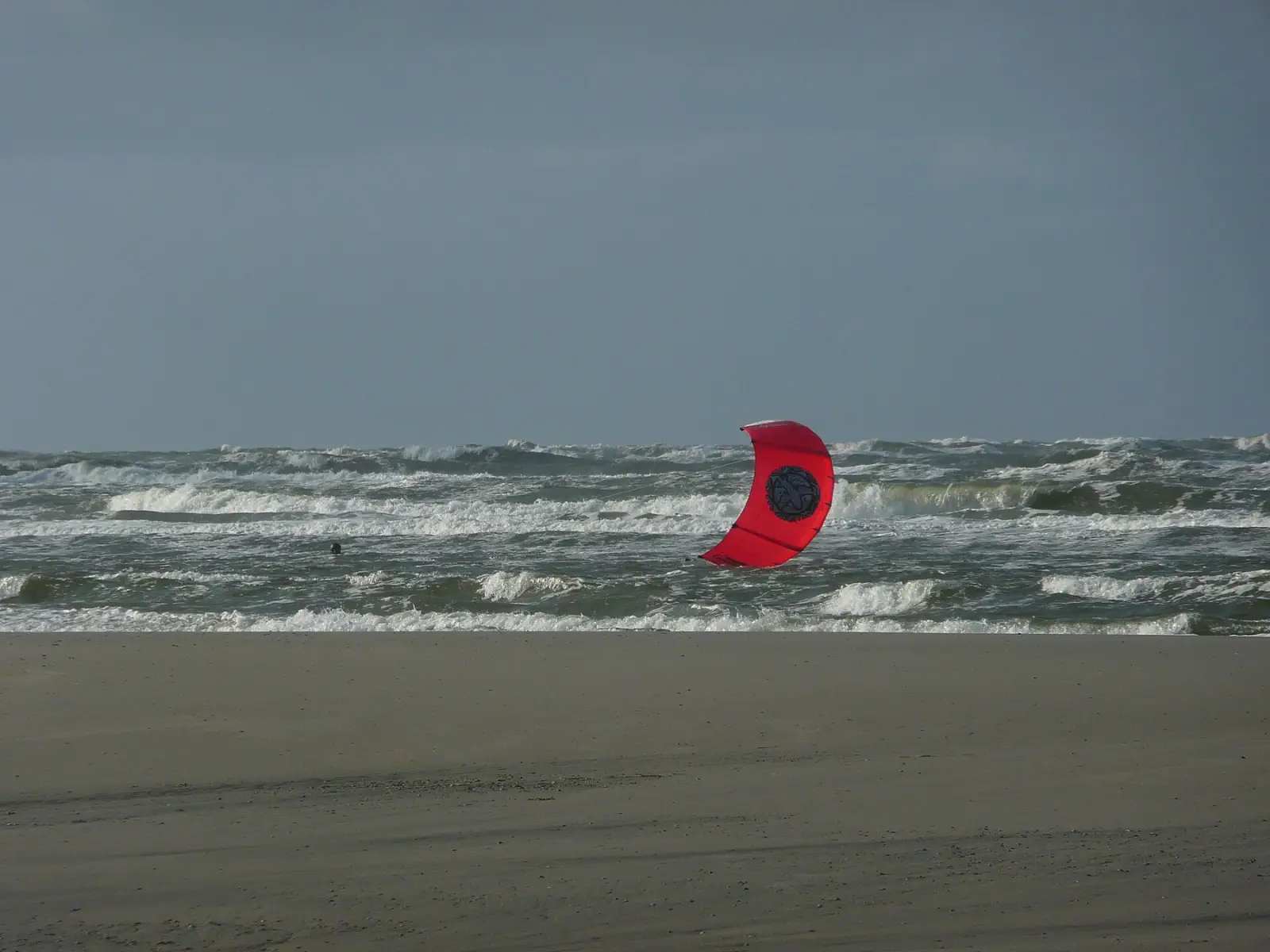
Too much wind is more dangerous than too little, because the mistake falls the wrong way. With too little wind you stand still and feel fed up. With too much wind you get lifted, sometimes while still on the beach, and then there is no water to land on. Kiters call that lofting. A review of all the research names as the main causes of injuries "uncontrolled actions and unsuccessful tricks and jumps with poor landings".5
04Gusts, the number people skip
An average of 22 knots with peaks up to 40 is a very different day from a steady 22. On this site an hour counts as gusty once the gusts go above 1.8 times the average, and above 1.6 times it recommends a size smaller. That is not normal: over 485 daylight hours at Hoek van Holland, the peak was usually around 1.4 times the wind. If you see a higher number, take it seriously.
05What is on the shore
The third reason, and the only one no app can check for you. Wind that pushes you towards the shore is safe as long as that shore is sand. Groynes, a beach bar, a basalt dyke, a pier or a car park turn the same wind into a problem. Before you rig up, walk down to the water's edge once, look downwind, and ask yourself where you end up if everything goes wrong.
06What really brings the risk down
Start with lessons. A study of more than three thousand kiters counted 65 serious injuries per thousand hours among beginners, and 1.1 among professionals.6 So your first hours are by far your most dangerous, and those are exactly the ones you spend at a school with someone beside you.
Know your quick release. In a German study from 2004, more than half of the injuries happened because the kiter could not get free of the kite when they lost control.7 That was in the days of the first systems. It is no miracle cure now either: a smaller study from 2025 found no difference in injuries between kiters with and without one.10 The thing only works if your hand knows where to go. The KNRM has a fixed rule for it:
Check that your QR works before every session and check your safety leash. You must be able to find and operate them blind. (translated)
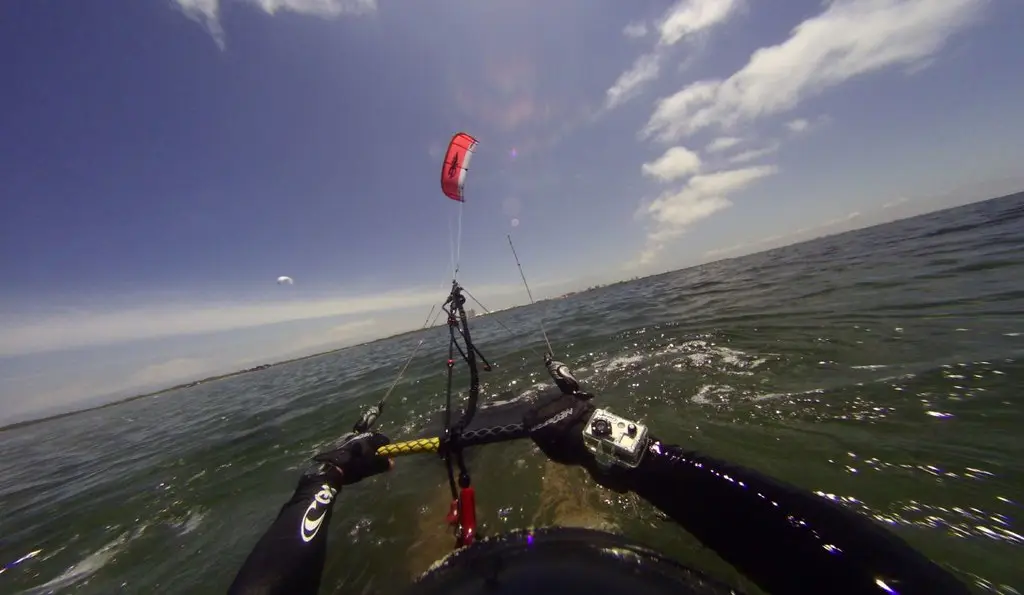
Ruben Lenten, one of the best-known kiters in the Netherlands, tells how it can go the other way too. During a jump he hit his quick release by accident, fell eight metres and broke his ankle in twenty places.8 So knowing where that thing is also means knowing where your hand must not go.
Don't go alone. "Our most important advice: never go surfing on your own" (translated), the KNRM writes.4 At a busy spot, someone sees it when you drift away.
Look at what the others are rigging up. If everyone is on a 7 while you roll out a 12, they know something you don't know yet.
And pick the day. Skipping a day costs nothing, because on the Dutch coast it blows at least once almost every week. Lenten, who became known for riding in storms, once said this about it:
What helps me a lot is to be physically, mentally and gear wise prepared. I know exactly what I can do.
The wind calculator puts the wind, the wind angle, the gusts and the current side by side for every hour, with the real wind stations alongside, for 63 spots on the Dutch coast.
07Further reading
- Learning to kitesurf. Where to start and who to learn from.
- How much wind do you need. The lower limit, and why it differs from person to person.
- What size kite for what wind. The full table, from 50 to 100 kilos.
Words in this article
Sources
- Van Bergen, Commandeur, Weber, Haverkamp and Breederveld, "Windsurfing vs kitesurfing: injuries at the North Sea over a 2-year period", World Journal of Orthopedics, 2016. PubMed
- Van Bergen, Weber, Kraal, Kerkhoffs and Haverkamp, World Journal of Orthopedics, 2020. PubMed
- Nederlandse Kitesurf Vereniging, "Externe omstandigheden" (External conditions, in Dutch). kitesurfvereniging.nl
- KNRM and Nederlandse Kitesurf Vereniging, "Tips voor surfers" (Tips for surfers, in Dutch). knrm.nl
- Bourgois, Boone, Callewaert, Tipton and Tallir, Sports Medicine, 2014. PubMed
- Offerhaus and colleagues, BMC Sports Science, Medicine and Rehabilitation, 2026. The kiters filled in afterwards themselves what happened to them, so the figure for beginners is rough. PubMed
- Nickel, Zernial, Musahl, Hansen, Zantop and Petersen, American Journal of Sports Medicine, 2004. PubMed
- Ruben Lenten in IKSURFMAG, issue 81, 2020. iksurfmag.com
- Ruben Lenten on the Windfinder blog. windfinder.com
- Bockmann and colleagues, Journal of Bodywork and Movement Therapies, 2025. PubMed
- Peter's Kiteboarding Handbook, "Choosing the right kite size". peterskiteboarding.com
- Kiteboardschool.nl, "Wanneer is het kitesurfweer" (When is it kitesurfing weather, in Dutch). kiteboardschool.nl