Learning to kitesurf: where do you start, and who do you learn from?
You learn to kitesurf from an instructor, on a calm day, with a small kite. Videos come after that. They help you understand what you felt in the lesson, and they prepare the next step. But they are not standing next to you when the kite does something you did not expect.
GuideThe order, the wind, learning abroad or on snow, and five channels to watch10 minute read
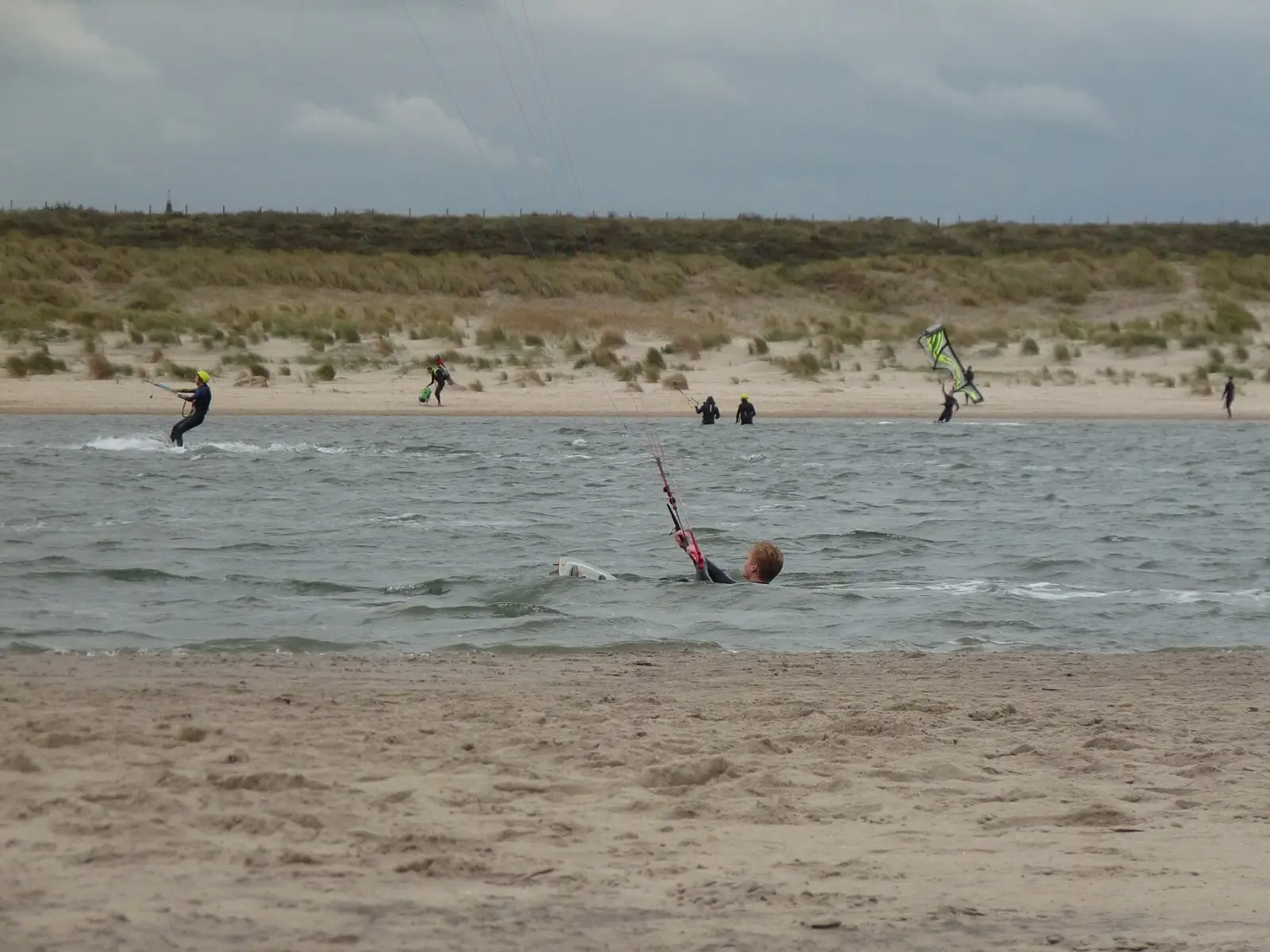
Take lessons at a recognised school, count on 8 to 12 hours before you can ride on your own, and only buy gear after that. Many accidents happen on the beach, when launching and landing the kite. That is exactly the part you learn in a lesson and not from a video.
Ruben Lenten is one of the best kiters the Netherlands has ever had. He started as a boy with "a 7m two-line kite and a directional board that I struggled with for three months to finally ride those first metres." (translated)1 Three months, with nobody to show him how. With lessons it goes a lot faster.
01How long it takes
Most people ride their first metres somewhere between the eighth and the twelfth hour of lessons. IKO, the largest organisation of kite schools, gives a similar figure and is honest about it:
Learning to kitesurf might take between 6 to 12 hours of lessons – but take this with a grain of salt. It often takes more than 12 hours and it rarely takes less than 6.
How fast it goes is not only down to you. The wind on your lesson days counts, and so does how shallow the water is. Book your lessons close together and you do not have to start over each time.
02The order that works
- Lessons. You learn to steer the kite, use the safety system, body dragging and the water start. Look for a school recognised by IKO or VDWS, with insured instructors.
- Riding on your own, but not alone. Do your first ten sessions at a spot with space, in wind that blows side-onshore, and with other kiters nearby who can help you land.
- Riding upwind. Only once you get back to where you started can you choose where you ride. Until then you walk back along the beach, board under your arm, kite above your head. Kiters call it the walk of shame, and everyone has done it, including the one jumping past you now.
- Only then tricks. Turning, jumping and the rest come faster once the basics happen by themselves.
Between step one and two there is a gap that many people fall into. Your lessons are over, you have bought gear, and suddenly you are standing alone on a beach. The Dutch kitesurf association has sober advice for that:
It is not strange at all to go out on the water without a board at first after your lessons, so you can practise body dragging again. (translated)
Once you can ride upwind, an organised downwinder is a great next step: with a group from beach A to beach B, the wind at your back, and a van back. Covering kilometres without turning. It is not for your first months, because along the way you have to be able to steer around piers and harbours. The kitesurf association is clear about it: "Riding upwind is crucial to avoid obstacles such as harbours and piers" (translated).14 And never go alone.
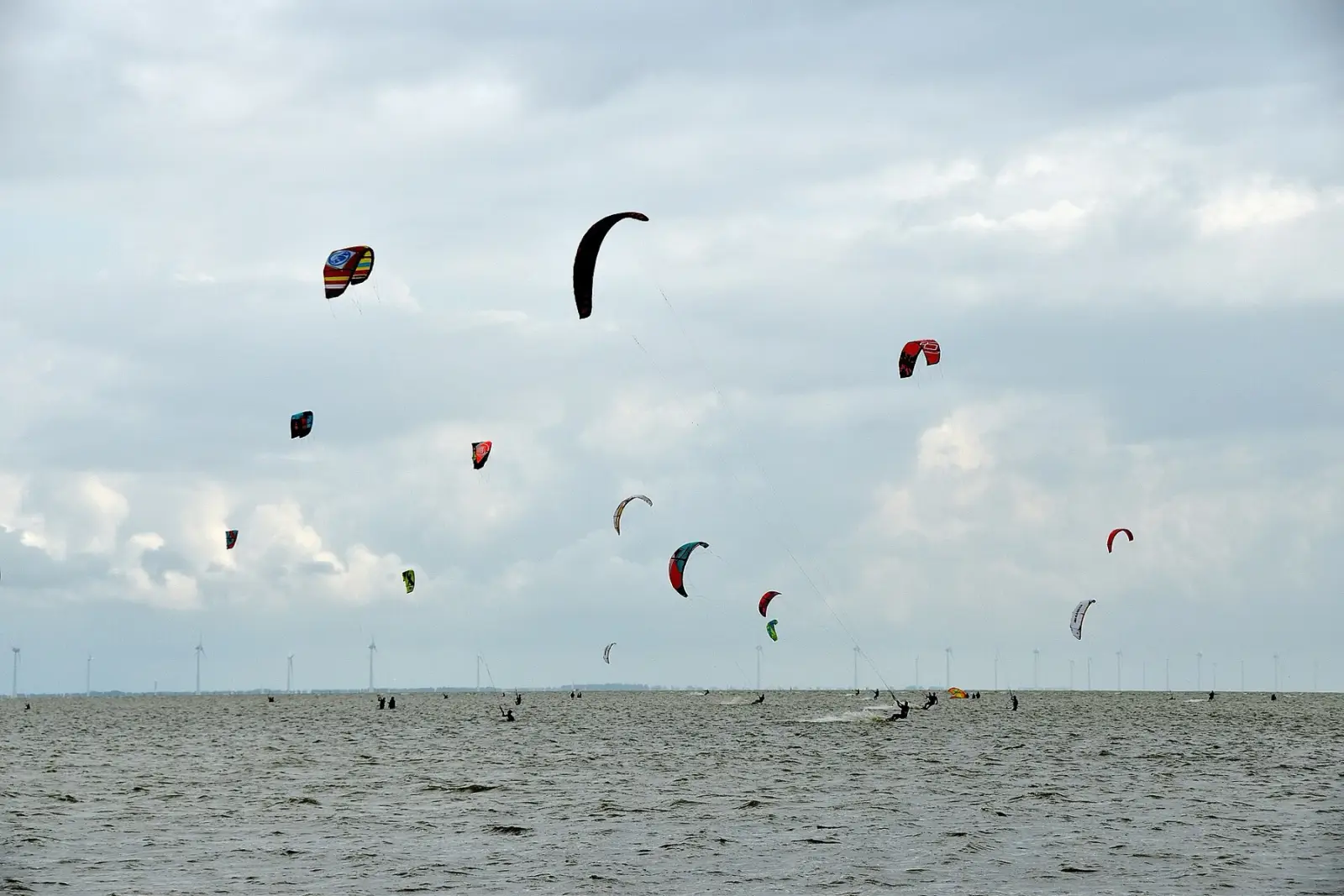
03What wind for a beginner
Between 14 and 20 knots, steady, and never offshore. With less wind the kite falls out of the sky. With more wind every mistake gets bigger. And gusty wind is harder for a beginner than strong wind, because you never know how much power is coming.
The wind calculator shows you the wind per hour, the gusts and whether the wind angle at that spot is safe. Also read what offshore wind means before you pick your first day on your own.
04Learning abroad
The hardest part of learning to kite in the Netherlands is the waiting. You have a lesson on Saturday, there is no wind, the next lesson is two weeks later, and by then you have forgotten half of it. A travel company for kiters puts it like this: "Learning at home is possible but much slower – too many breaks, too many no-wind days, not enough continuity."4 They sell trips, so they have an interest in saying so. They are not wrong, though.
At the good places the wind blows almost every day, often as thermal wind. The sun warms the land faster than the sea, the warm air rises, and cooler air from the sea flows in underneath. On sunny days that gives wind every afternoon.5 Add a shallow lagoon and you are on the water every day for a week. That many hours in a row is exactly what you need as a beginner.
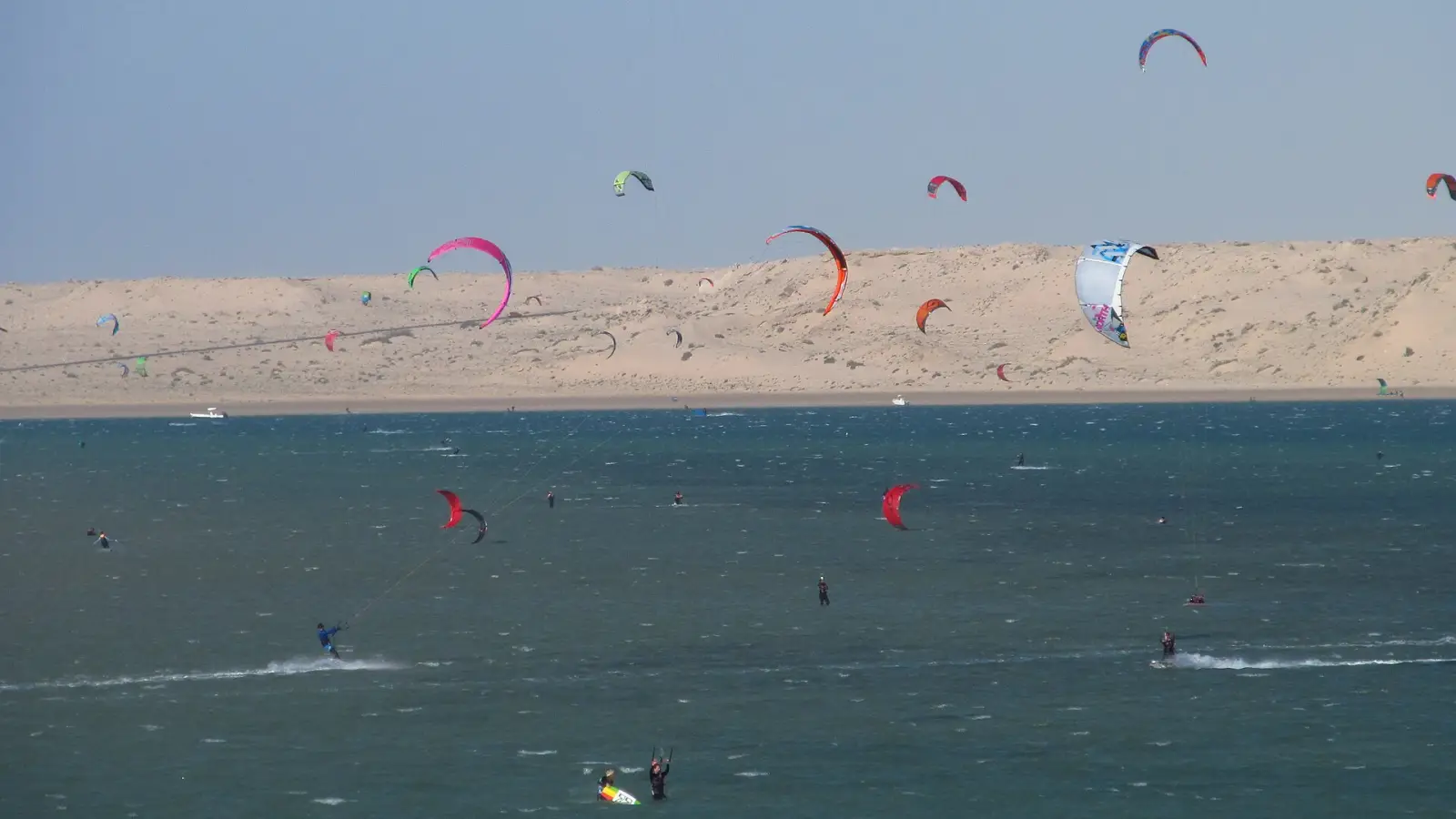
Places where Dutch kiters often learn:
| Place | When | Why |
|---|---|---|
| Dakhla, Morocco | Almost all year | A huge flat lagoon with wind from the side. |
| El Gouna, Egypt | Many months a year | Thermal wind of 12 to 25 knots, shallow and flat. |
| Lo Stagnone, Sicily | Spring and summer | Knee-deep water, no waves. |
| Paje, Zanzibar | May to September, December to March | Shallow lagoon. Watch the tide: at low tide a large part dries out. |
| Tarifa, Spain | March to May, October and November | Lots of wind, and much quieter on the beach outside the summer. |
| Marmari, Kos | May to September | A 50 metre sandbank keeps the water shallow and sheltered. 7 to 21 knots in the afternoon. |
| Prasonisi, Rhodes | April to October | A strip of sand with waves on one side and glassy flat water on the other. It does get busy, and that is tricky when you are just starting. |
| Sotavento, Fuerteventura | May to September | A big lagoon with its own lesson areas. It only fills at high tide, and the wind is strong there: 20 to 30 knots on average. |
Seasons and descriptions from travel companies and local schools.46715 Always check the wind statistics of the place for your own week.
Not every beautiful island is a place to learn. Lefkada is popular, but Milos Beach has deep water and rocks along the shore, and is recommended for people who can already ride.16 Save that for the year after.
Then the money. A local school can be a good deal cheaper than at home, and sometimes there is a reason for that. Lesson gear has a hard life: "School kites take a serious beating over the course of a year, as learners crash them repeatedly into the sand or in the water."8 A worn-out kite with a stiff safety system is not something you want above your head. So check what you are booking:
- Is the school recognised? IKO and VDWS both have a search tool where you can look it up.9
- How many students per instructor? The fewer, the more you ride. Some schools put six with one instructor.8
- Is there a boat? One school has a jet ski to pick you up, another only a kayak.8
- How old is the gear? Ask, and read reviews with photos.
- Can you come and watch? A good school is fine with you watching a lesson first.8
If you would rather not do that research yourself, you can go with a Dutch organisation that has already picked the school and the place. KiteActive goes to Zanzibar, Brazil and Sicily, among others, Ripstar to Dakhla and Egypt with lesson groups of at most three, and De Kitesurfbus drives to Portugal, Morocco and southern Spain in winter.10 The same applies here: Kitewind has no ties with any of them, and they do not know they are listed here.
05Snowkiting, learning without water
The hardest thing about the first days of lessons has little to do with the kite. It is the water: you lie in it, you get dragged through it, and the water start has to work before you ride even a metre. On snow all of that falls away. You are already standing, on skis or a snowboard, and the kite only has to get you moving. A Swiss school: "You can stand on snow, which of course makes the processes much easier compared to kitesurfing."11 What you learn there about steering and stance you take with you to the water.
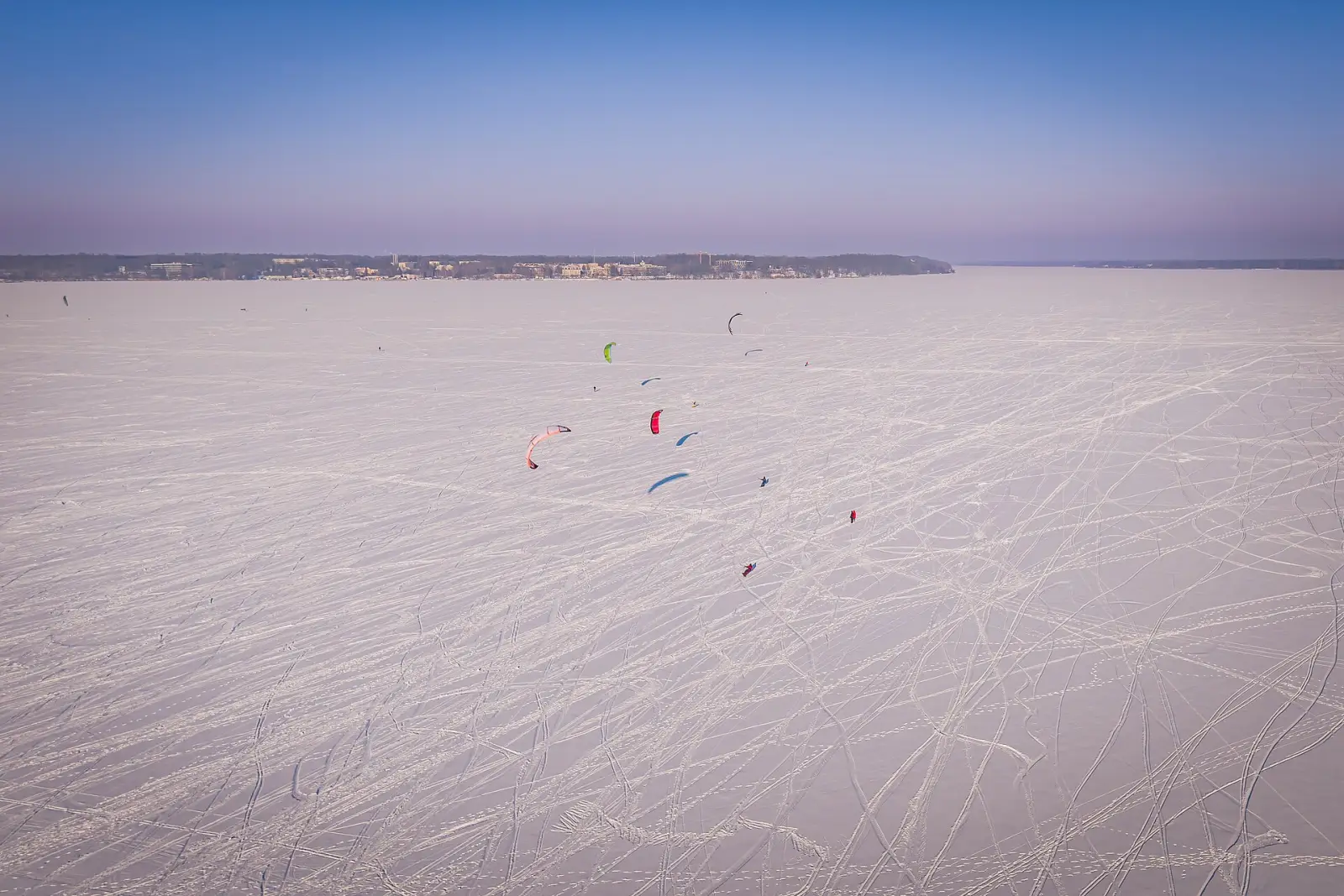
Dutch kiters mostly go to the Hardangervidda in Norway for this, in February and March. Ripstar and the Scheveningen shop Versus, among others, organise trips there, beginners included.12
Do not underestimate it. Snow is harder than water, and wind in the mountains is unpredictable. Doctors counted 8.4 injuries per thousand hours among snowkiters. That is comparable to kitesurfing. Among beginners it was 20.8, and the researchers call it a high-risk sport.13 So take lessons here too, and wear a helmet.
06YouTube channels to learn from
Five well-known channels with instruction, to watch alongside your lessons. Kitewind has no ties with any of these channels, brands or shops. There is no sponsorship, there are no links anyone earns from and no agreements, and they do not know they are listed here. Two of the five belong to a brand or a shop. That is stated next to them, so you know who is talking.
- Kitesurf College (English). Instruction videos from a kite school, from the basics to advanced.
- Progression Sports (English). One video per technique, for every level.
- Get High with Mike (English). Coaching for when you can already ride and want to learn to jump.
- Kitemana (Dutch, a shop). Videos about gear and technique. It is a shop, so they sell what they review.
- Duotone Kiteboarding (English, a brand). Technique videos alongside their own product films. The gear on screen is theirs.
Is a channel missing that belongs here, or is something no longer right? Let us know.
07What a video does not teach you
The safety system under load, to start with. Letting go of the bar, using the quick release, releasing the kite completely: in a video it looks logical. With a kite pulling at you full force, it is not. Practise it in lessons until your hand does it by itself.
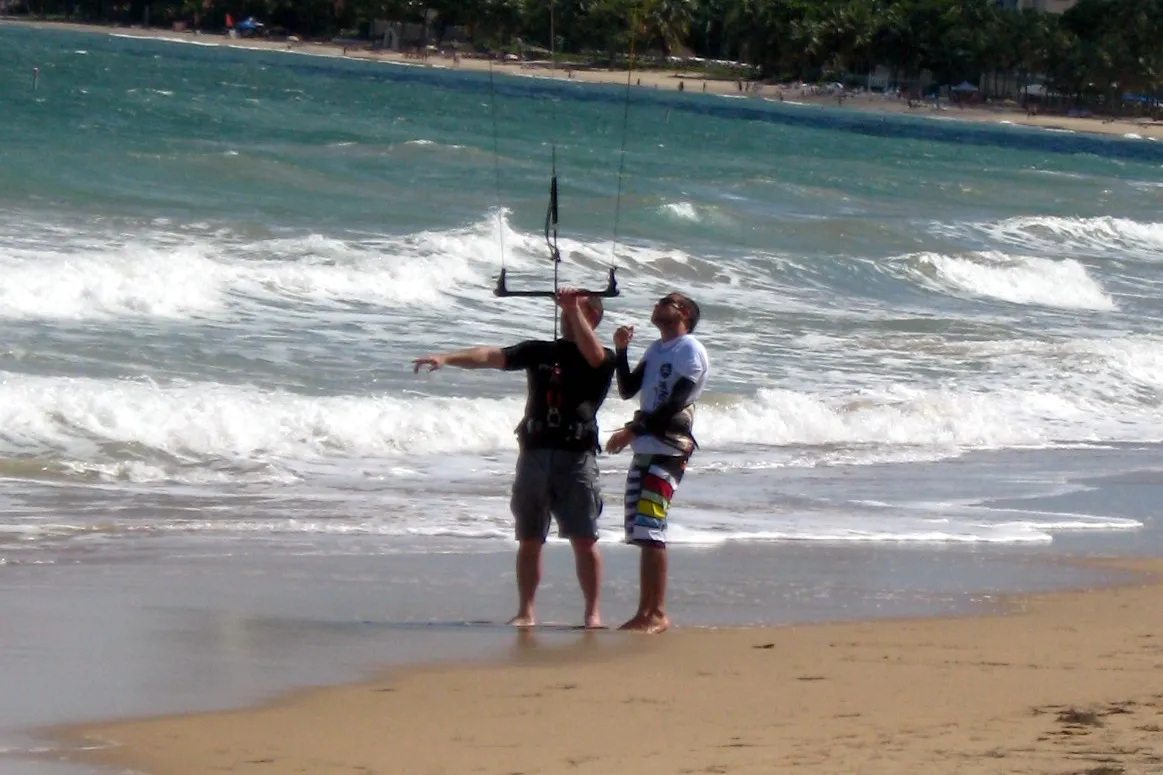
Launching and landing with someone else is also something you only learn on the beach. That comes with agreed hand signals, and the habit of saying no when it does not feel right.
And then reading the place. Where do you drift if it goes wrong, and what is there? An instructor points it out to you once on your own beach, and after that you see it everywhere.
Enter your weight and your biggest kite. The wind calculator shows per hour whether there is enough wind, whether it is not too much, and whether the wind angle at that spot is safe.
08Further reading
- How much wind do you need to kitesurf
- What size kite for what wind
- Is kitesurfing dangerous, and what is offshore wind
Words in this article
Sources
- Ruben Lenten in an interview with Ridersguide (in Dutch). ridersguide.nl
- IKO, "How long does it really take to learn to kitesurf". ikointl.com
- Nederlandse Kitesurf Vereniging, "Eigen vaardigheid" (Your own skills, in Dutch). kitesurfvereniging.nl
- KiteWorldWide, a travel company, "Learn kitesurfing: everything you need to know". kiteworldwide.com
- The Kitesurf Centre, "Sea breezes and how to kitesurf with them". thekitesurfcentre.com
- KiteActive, "Kitespot guide Zanzibar". kiteactive.com
- Rebels Tarifa, a kite school, on the best time of year. rebelstarifa.com
- Kitesurfist, "How to choose a good kitesurfing school". kitesurfist.com
- The school finders of IKO and VDWS.
- The own websites of KiteActive, Ripstar and De Kitesurfbus.
- Swiss Snowkiting School, frequently asked questions. snowkiting.ch
- Versus, snowkite trip to the Hardangervidda, and Ripstar. versusshop.nl
- Moroder and colleagues, American Journal of Sports Medicine, 2011. PubMed
- Nederlandse Kitesurf Vereniging, "Veilig een downwinder doen" (Doing a downwinder safely, in Dutch). kitesurfvereniging.nl
- Sportif Travel on Marmari on Kos, IKSURFMAG on Rhodes and Kiteguide on the Sotavento lagoon.
- Spots4Kite, "Kitesurfing in Greece". spots4kite.com