How much wind do you need to kitesurf?
Ask on a beach and you'll hear "fifteen knots or so". That answer is right for exactly one person. How much wind is enough depends on how heavy you are and how big your biggest kite is, and from one kiter to the next those two can easily make ten knots of difference.
GuideWith the formula and four real sessions6 minute read
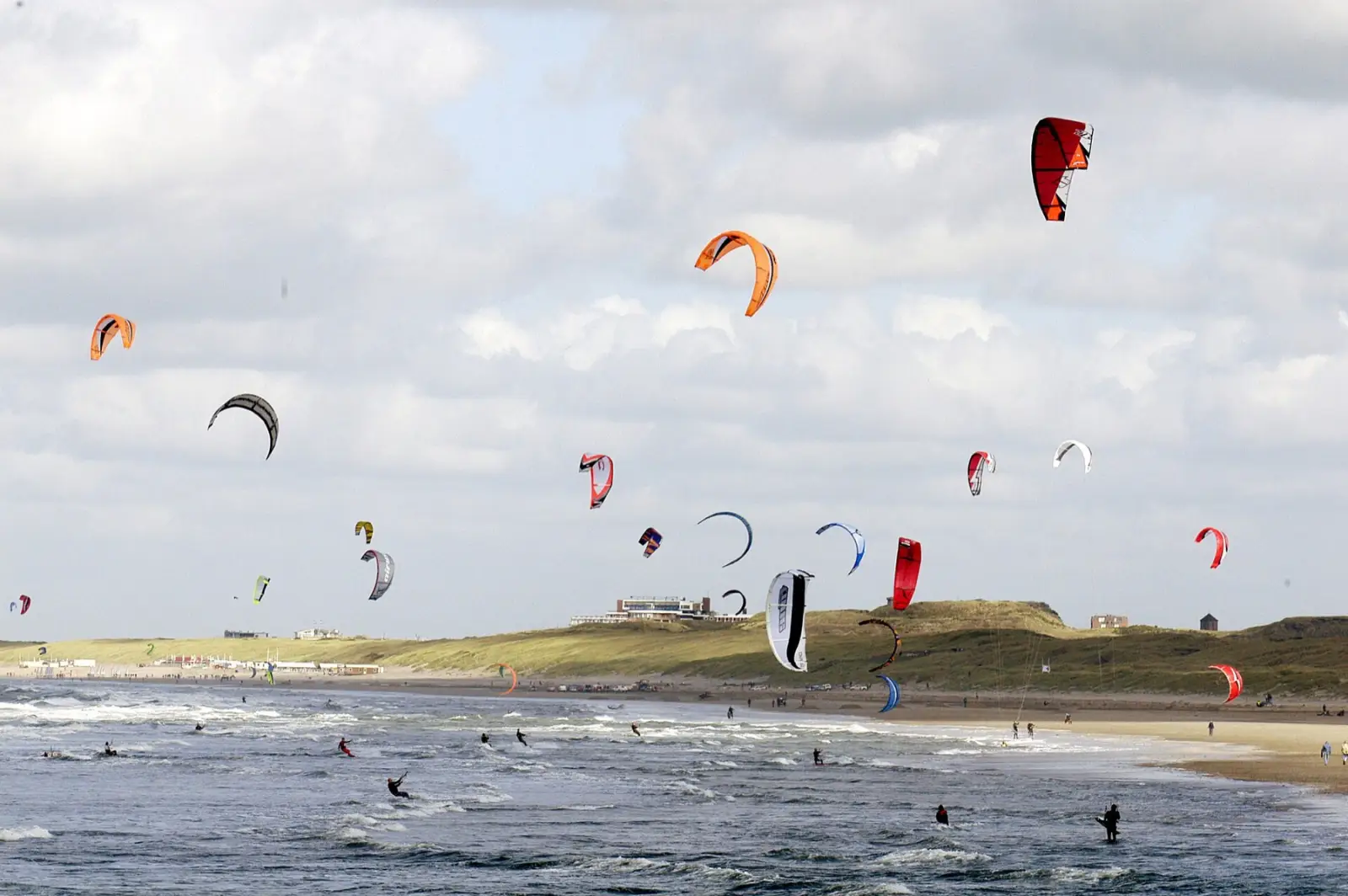
If you weigh 85 kilos and have a 13 metre kite, you ride comfortably from 14 knots. With a 9 metre the same person needs 21 knots, with a 17 metre only 11. Ten knots of difference, and the weather stayed the same the whole time.
Put a heavy and a light kiter side by side on the same beach. The light one is already jumping, on a big kite. The heavy one is standing knee-deep in the water, waiting for a gust. They are looking at the same wind meter. That is why this site never gives a single number, and why the calculator first asks what you weigh.
01The formula
Everything on Kitewind runs on one rule of thumb. It is short enough to remember:
kite sizein square metres= 2.2 × your weightin kilosthe windin knots
Turn it round and you have the answer to the question in this article. At what wind does your biggest kite start to pull?
the wind you needin knots= 2.2 × your weightin kilosyour biggest kitein square metres
Take 85 kilos and a 13 metre. 2.2 times 85 is 187, and 187 divided by 13 is 14 knots. At that wind the kite is exactly the right size. A few knots below that you still get up and riding, with little power and a lot of pumping on the bar. Below 12 it stops. You can see how much weight counts if you give the same 12 metre to three people:
| Weight | The sum | The kite fits at |
|---|---|---|
| 50 kg | 2.2 × 50 = 110, divided by 12 | 9 knots |
| 75 kg | 2.2 × 75 = 165, divided by 12 | 14 knots |
| 95 kg | 2.2 × 95 = 209, divided by 12 | 17 knots |
Same beach, same kite, eight knots of difference. On a day with 13 knots the first one has a great session and the third goes home again.
Try it yourself
12knots, from here it works
- marginal
- it works
- good
- strong
- stay ashore
Ideally, you want steady wind with an average strength in the range of 15-20 knots.
02On a surfboard or a foil you need less wind
If you ride a directional, a board shaped like a surfboard, you need less kite than on a twintip. The board is bigger and floats better, so it gets going sooner. That is why the formula takes 1.5 metres off the ideal size.
That number has been tested. With 2 metres off, the site called a session overpowered that was a lovely ride in reality. With 1.5 it was right.
A hydrofoil goes further still. The wing under the board lifts you out of the water, and then you ride in wind where everyone else is sitting on the beach. That takes 2.5 metres off. Why exactly that number is explained on the kite sizes page.
03From too little to too much
Above your lower limit there are four more limits. The lower ones move with your weight and your kite. The top two are fixed at 30 and 40 knots, because whether it is blowing too hard is a question of safety, not of size. The table follows what you set above.
Set now: 85 kg, 13 m, twintip
| Wind | What you notice |
|---|---|
| under 12 kn | Too little. Your biggest kite won't pull you out of the water. |
| 12 to 14 kn | Marginal. You ride, but you have to work for it. |
| 14 to 19 kn | It works. Biggest kite, cruising back and forth. |
| 19 to 30 kn | The good range. Enough power to jump. |
| 30 to 40 kn | Strong. Fine, but only with a small kite. |
| over 40 kn | Stay ashore. The site counts this as a no. |
If you enter a different weight or a different kite, the 12, the 14 and the 19 move. The 30 and the 40 stay put.
04Where the numbers come from
The rule of thumb itself is not ours. It has been going around among kiters for years, and where it comes from and how it holds up against other size charts is on the kite sizes page. Exactly where the limits lie, so when "just about works" turns into "now it's fun", is not set down anywhere. Here they are tuned to real sessions: after riding, the wind, the kite that was up and how it felt were written down.
One example. At 17 knots on a 13 metre, it was still just about a session for 85 kilos. That is why the lower limit is this low, and not at a safe 18 that would keep you at home for half the summer. With every change to the site, a test checks that those sessions still come out right.
It remains a rule of thumb based on weight. How well you ride counts too: experienced riders hold on to a kite longer in strong wind and get it going sooner in light wind. Treat the result as a starting point, and always look at what the rest of the beach is rigging.
05Gusts count
The average tells half the story. A wind meter showing 20 knots with peaks of 34 pulls almost three times as hard on your lines at those peaks, because the force of the wind grows with the square of its speed. So you pick your size for the peak.
The weather forecast won't help you here. The wind force the KNMI (the Dutch weather service) gives is an average over ten minutes,2 and a lot of gusts fit into ten minutes. The Dutch kitesurfing association warns above all about squalls, which bring "treacherous gusts (or wind holes)" (translated).3 If you see a squall coming, get ashore first.
The site uses two limits. If the gusts go above 1.6 times the average wind, it recommends a size smaller. If they go above 1.8 times, the day counts as gusty and loses points. That does not happen often. Over 485 daylight hours at Hoek van Holland, the peak was usually around 1.4 times the wind, and in nine out of ten hours between 1.2 and 1.67.
06And what is a knot, anyway
A knot is one nautical mile per hour, about 1.85 kilometres per hour. The weather forecast prefers to talk in wind force. This is the rough conversion:
| Knots | Force | Kilometres per hour |
|---|---|---|
| 14 kn | 4 | about 26 |
| 19 kn | 5 | about 35 |
| 30 kn | 7 | about 56 |
| 40 kn | 8 to 9 | about 74 |
The KNMI puts force 4 at 11 to 16 knots, 5 at 17 to 21, 6 at 22 to 27 and 7 at 28 to 33.2 So most kiting days on the Dutch coast are force 5 or 6. The full scale is at wind force to knots.
Enter your weight and your biggest kite and pick your spot. You see today's wind and the coming week hour by hour, alongside what the wind stations are measuring right now.
07Further reading
- What size kite for what wind. The full table, from 50 to 100 kilos.
- Is kitesurfing dangerous. About offshore wind, and what really goes wrong.
- Learn to kitesurf. Where to start and who to learn from.
Words in this article
Sources
- IKO, "How long does it really take to learn to kitesurf". ikointl.com
- KNMI, "Windschaal van Beaufort" (Beaufort wind scale, in Dutch). knmi.nl
- Nederlandse Kitesurf Vereniging (Dutch Kitesurfing Association), "Externe omstandigheden" (External conditions, in Dutch). kitesurfvereniging.nl